DiffuSpace’s Clover-35B-A3B-Preview gained a detailed technical report on 18 November, following its original announcement on 30 October. The model has 35 billion parameters, with about three billion active per token. It uses diffusion to fill and revise blocks of text in parallel, instead of relying solely on conventional sequential generation.
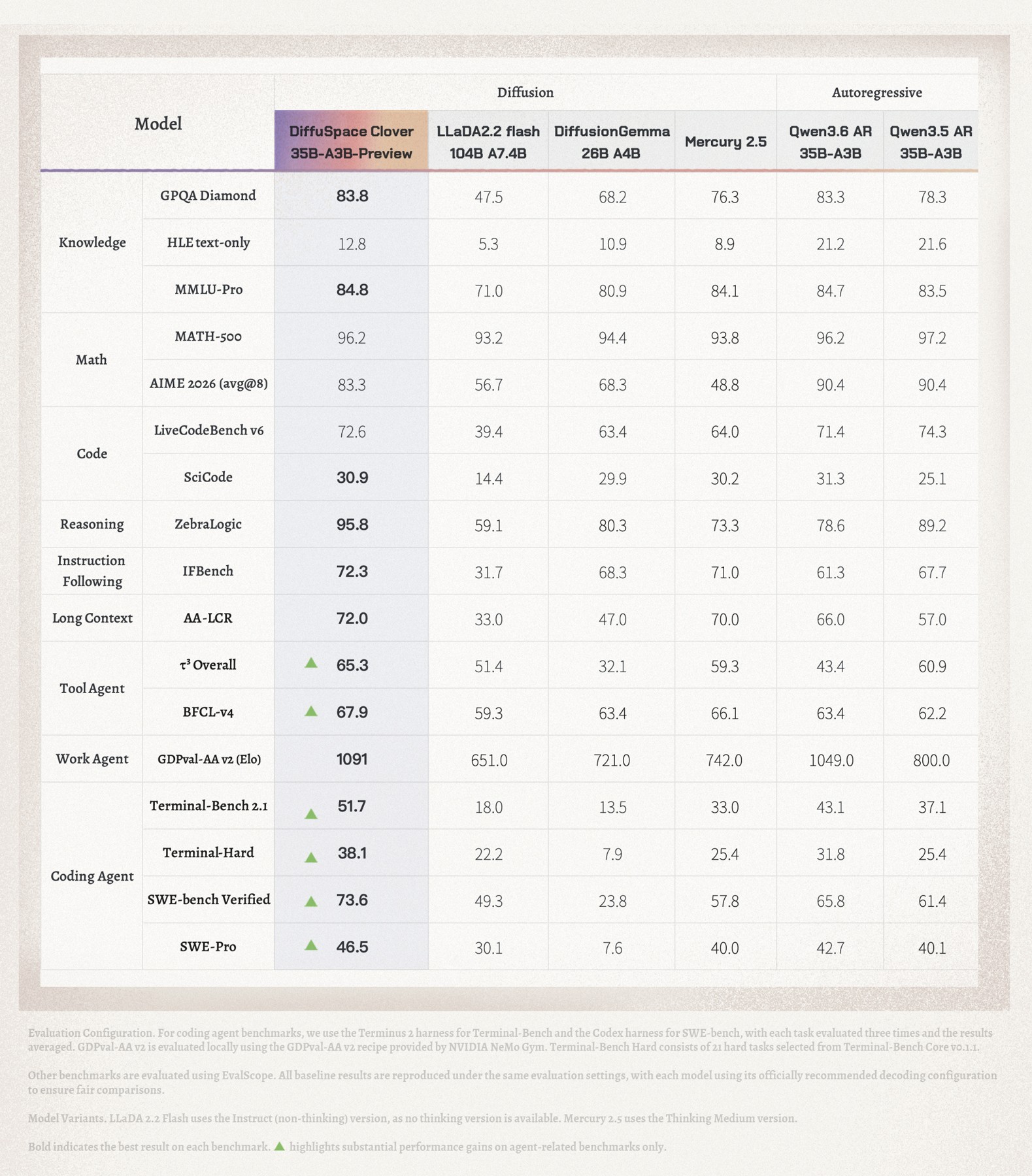
The team reports 73.6 on SWE-bench Verified and 51.7 on Terminal-Bench 2.1. These are its own evaluations. The official comparison table does not show leadership everywhere: Clover scores 12.8 on text-only HLE, below the 21.2 and 21.6 of the two listed Qwen models.
Speed needs a denominator
The striking figure of 680 tokens per second comes from a particular agent-prefix replay test on one NVIDIA GB300. The paper explicitly says this throughput test does not measure task success. An agent can produce text quickly while requiring more attempts to reach the correct outcome.
Weights are available under Apache-2.0, alongside inference implementations. The model card specifies a 128K-token context window and approximately 69 GB for BF16 weights before additional runtime memory. It also records potential repetition in long responses.
The significance lies in competition over how text is generated. Practical value for development tools will depend on time to a successful task, cost and consistency. Tokens per second describe only one part of that journey.
Our sources
- Clover announcement ↗DiffuSpace Core Team · 30 October 2026 · Checked 23 November 2026
- Clover-35B-A3B-Preview Technical Report ↗DiffuSpace Technical Team / arXiv · 18 November 2026 · Checked 23 November 2026
- Clover model card ↗DiffuSpace / Hugging Face · Checked 23 November 2026
- Clover implementation and benchmark table ↗DiffuSpace / GitHub · Checked 23 November 2026
AI tools assist our editors. Articles are published after human approval. Practical examples are ΠΕΡΑ analysis unless stated otherwise. How we work