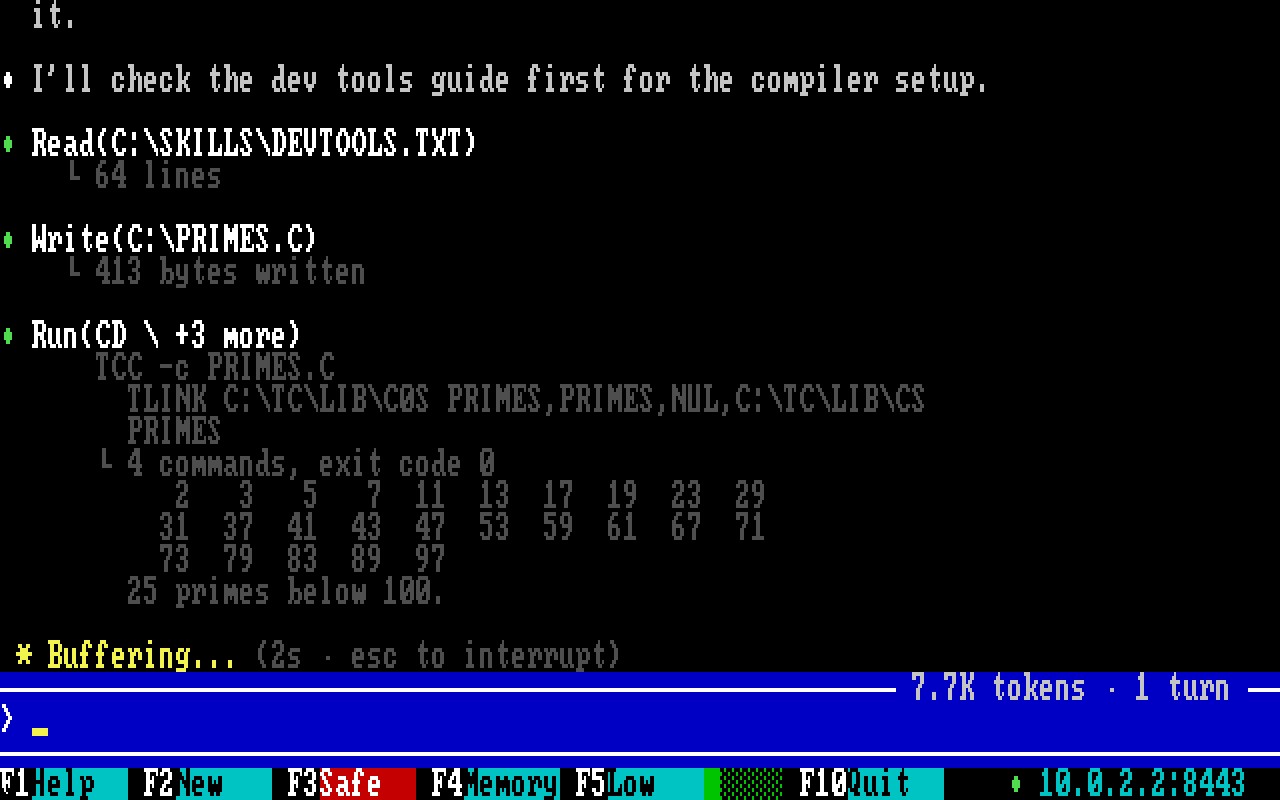
An IBM PC XT with an 8088 processor and 640 KB of memory can now host an interface that writes and runs programs. ClawDOS, a personal experiment by the developer Ricapar, has public source code and documentation. It does not run Claude on vintage hardware: it connects to the remote model through an API.
That distinction explains the project’s appeal. DOS handles the screen, files and command execution. A separate modern computer manages the encrypted TLS connection. The language model’s computing power sits across the network, while the old PC remains the environment where actions happen.
Tools still need permission
The manual describes tools for reading, searching, editing and running files, alongside notes that persist between conversations. Safe mode, enabled by default, asks for human approval before changes. The API reference also describes what leaves the machine; running tools locally does not mean their content stays exclusively on the PC.
The presentation’s screenshots come from an 86Box emulator and document the developer’s demonstration. The code uses GPL-3.0-or-later, while Turbo C has separate rights and requires the user’s own copies.
The experiment illustrates a consequential design choice: an agent can combine a very light local interface with a powerful remote model. That expands the range of devices able to participate, while retaining dependencies on connectivity, a service provider and control over actions.
Our sources
- ClawDOS ↗Ricapar · Checked 23 November 2026
- ClawDOS manual ↗Ricapar / GitHub · Checked 23 November 2026
- ClawDOS API contract ↗Ricapar / GitHub · Checked 23 November 2026
- ClawDOS licence ↗Ricapar / GitHub · Checked 23 November 2026
AI tools assist our editors. Articles are published after human approval. Practical examples are ΠΕΡΑ analysis unless stated otherwise. How we work