Perplexity introduced its Monitor API on 16 November, giving applications a service that checks the web periodically and signals relevant changes. Search no longer has to begin with a fresh question every time: it can become a continuing input to a workflow.
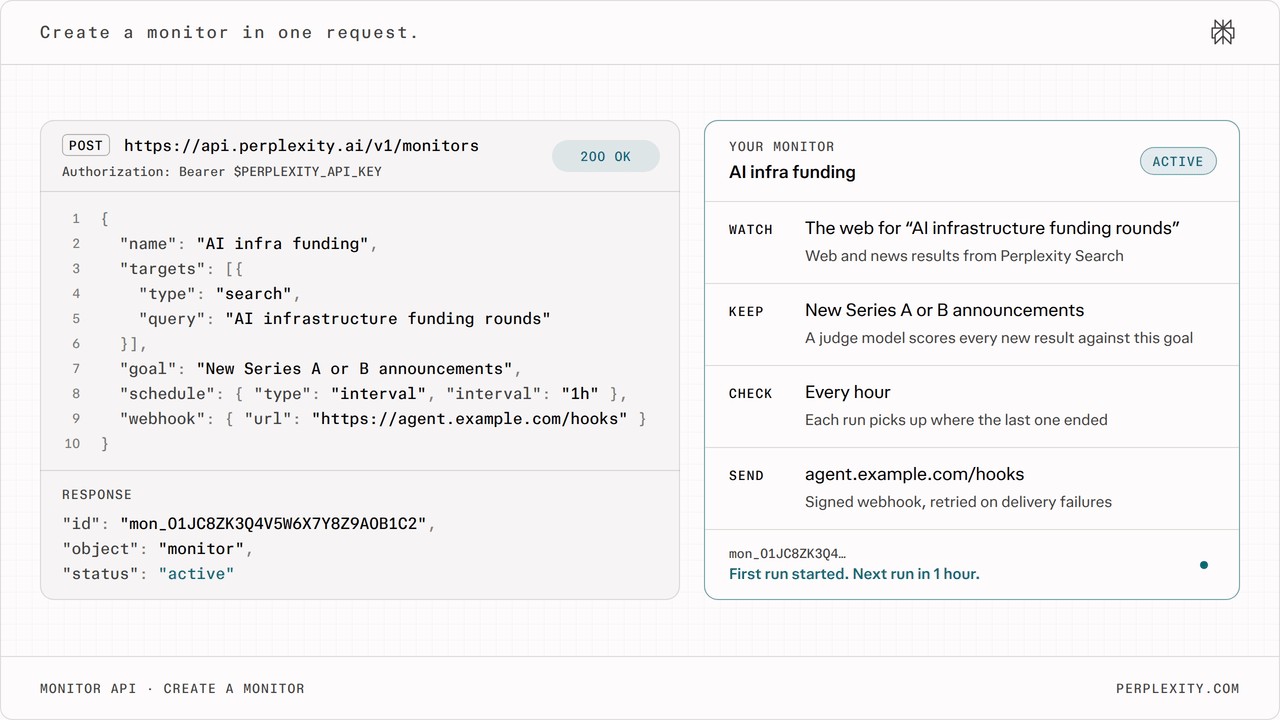
There are two modes. Topic monitoring searches for new information, while page monitoring compares changes at up to ten URLs. Developers specify a natural-language goal and a checking schedule. Updates can arrive through a signed webhook, an automatic call to the receiving application.
A filter is not a decision
In the official demonstration, a goal retains Series A or B funding announcements. The frame shows a query, a filter, hourly checking and a recipient connected together. It does not establish the accuracy of every finding or the wisdom of a subsequent business action.
The documentation says organisations requiring zero data retention cannot create or run monitors. Repeated source or delivery failures can also trigger an automatic pause. Monitoring therefore does not guarantee uninterrupted operation.
The price list checked on 23 November charges $1 per 1,000 successful Search runs, or per 1,000 counted URLs for Page monitoring. The service removes some maintenance work from a monitoring pipeline. Assessing the information and approving consequential actions remain separate functions.
Our sources
- Introducing Perplexity’s Monitor API ↗Perplexity · 16 November 2026 · Checked 23 November 2026
- Monitor API announcement ↗Perplexity Developers · 16 November 2026 · Checked 23 November 2026
- Monitor API overview ↗Perplexity · Checked 23 November 2026
- Monitor API pricing ↗Perplexity · Checked 23 November 2026
AI tools assist our editors. Articles are published after human approval. Practical examples are ΠΕΡΑ analysis unless stated otherwise. How we work