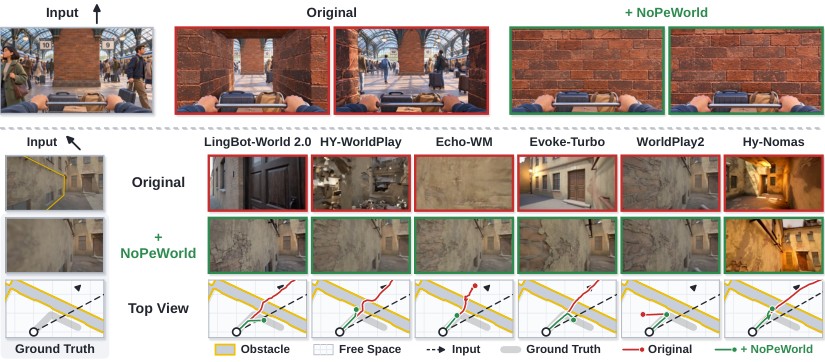
Models that generate interactive worlds can draw convincing corridors and still let the camera travel through walls. On 20 November, researchers at The Hong Kong Polytechnic University presented NoPeWorld, a method that intervenes before movements produce these violations. Code and related research resources followed on 21 November.
The study reports that the average physical-obstacle violation rate across six models falls from 74% to 16%. Those are the researchers’ results on defined tests, rather than evidence of safety in the physical world.
A small intervention inside the generator
NoPeWorld reads internal representations from an already trained video model. A small additional component predicts penetration risk and replaces problematic movement with a safer alternative. The underlying generator remains frozen.
The release includes NoPeBench, a benchmark designed around obstacles. Availability comes with several layers of terms: the code uses Apache-2.0, but the underlying models and datasets retain separate conditions. Publishing an experiment openly does not turn all its ingredients into one commercially unrestricted package.
For generated games and simulations, the question shifts from visual plausibility to consistent interaction. A world needs to resist impossible commands while preserving the user’s intended direction. NoPeWorld offers a measurable research approach to that challenge, with errors still remaining.
Our sources
- Non-penetrating World Models ↗Dai et al. / arXiv · 20 November 2026 · Checked 23 November 2026
- NoPeWorld implementation and release notes ↗Hong Kong Polytechnic University / GitHub · 21 November 2026 · Checked 23 November 2026
- Project and demonstrations ↗NoPeWorld team · Checked 23 November 2026
AI tools assist our editors. Articles are published after human approval. Practical examples are ΠΕΡΑ analysis unless stated otherwise. How we work