A brief inconsistency in movement, a distorted letter or audio that does not fit the image can determine the next question. WeVisForensics follows that approach to detecting AI-generated video. Researchers from Nanjing University and Tencent's WeChat Vision presented the system in a paper submitted on November 16.
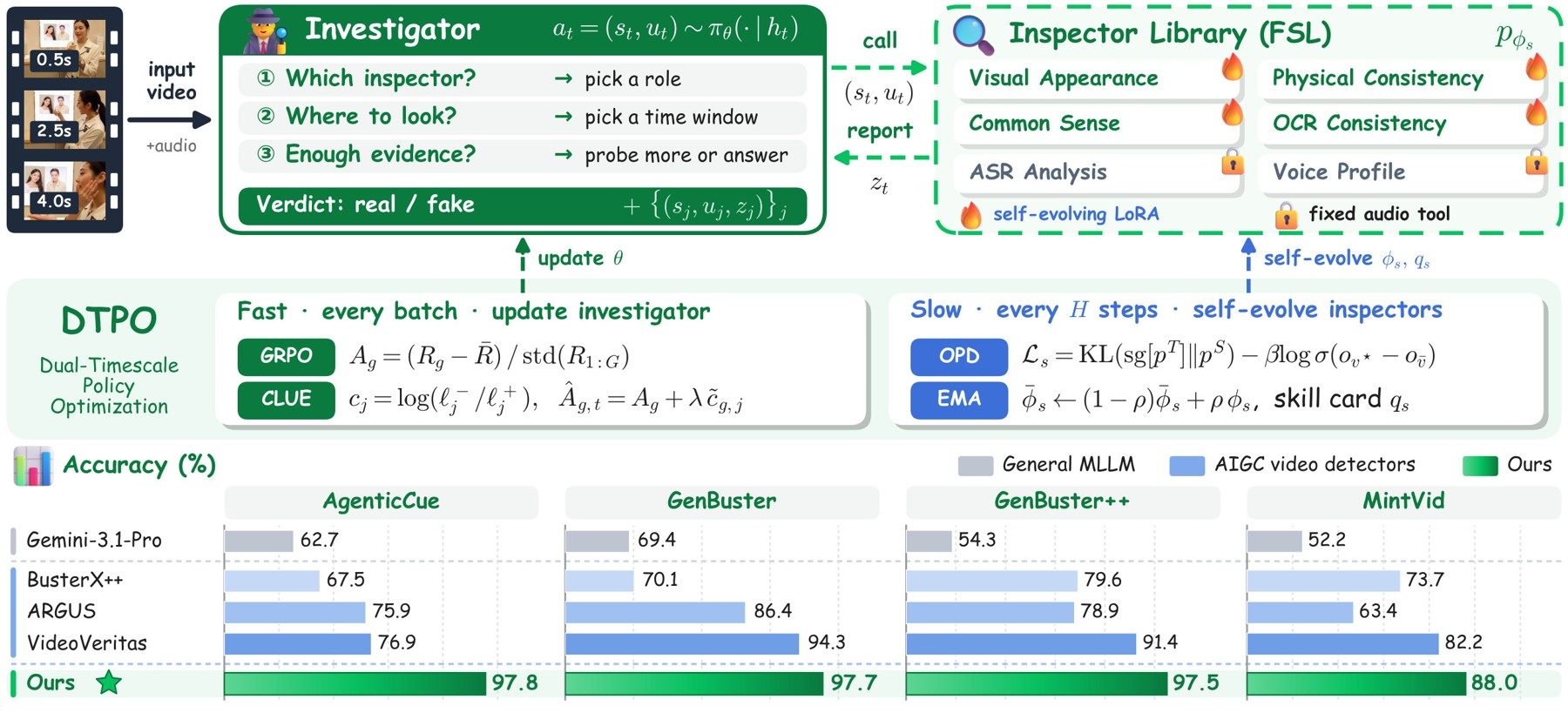
An investigator agent chooses a time window and assigns it to a specialist inspector. Separate checks cover appearance, physical consistency, common sense, on-screen text and audio. The system receives reports before reaching its classification.
Accuracy within the tested conditions
The authors report average accuracy of 95.2% in their evaluations, against 86.2% for the strongest previous average result: a difference of nine percentage points. The paper's diagram brings together different benchmarks. These figures do not guarantee correct identification of every video circulating online.
The release includes Apache 2.0 code, adaptation weights and a demo. Documentation describes local operation on a single GPU with at least 24 GB. Browsing recorded examples without a GPU is different from running live analysis on new material.
Showing which trace led to a conclusion makes the framework relevant to misinformation research. Its output remains a model classification, however. It does not replace a file's provenance, metadata or the journalistic and forensic investigation needed for a disputed recording.
Our sources
- WeVisForensics paper ↗Du et al. / arXiv · 16 November 2026 · Checked 22 November 2026
- WeVisForensics full paper and Figure 2 ↗Du et al. / arXiv · 16 November 2026 · Checked 22 November 2026
- WeVisForensics repository and deployment documentation ↗Tencent · Checked 22 November 2026
- WeVisForensics project page ↗Tencent / Nanjing University · Checked 22 November 2026
AI tools assist our editors. Articles are published after human approval. Practical examples are ΠΕΡΑ analysis unless stated otherwise. How we work