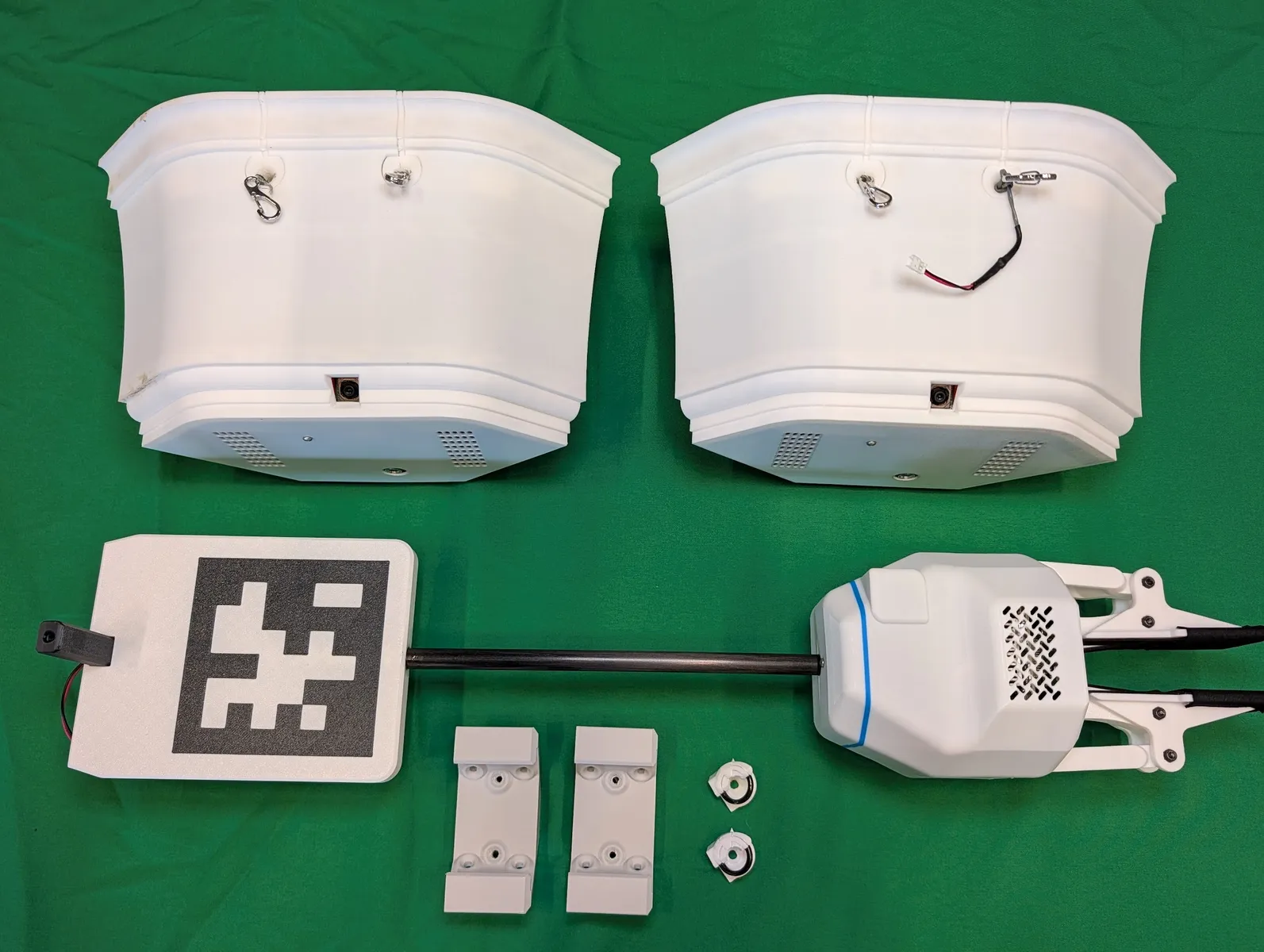
Four thin lines and two mechanisms mounted in room corners move Stringman’s gripper through the air. Neufangled Robotics’ prototype drew attention on Hacker News on November 3. Its documentation was already public in October; the new discussion brought the design to a wider audience.
Motorised spools wind the lines, while cameras track printed markers to estimate the gripper’s position. A separate computer runs the motion controller, and the operator uses a browser interface. The interface can also record demonstrations for training control models, and the project documents an integration with LeRobot.
The prototype’s limits
Neufangled lists a price of $795 on the product page. A comparison with a laboratory arm is useful for understanding the space the gripper can reach, but it gives no guarantee of equivalent precision or safety. Installation requires suitable mounting points. The documentation says the system has no automatic obstacle avoidance and warns that fast movements can lead to collisions.
Build files and software are public. The project’s pages give different accounts of the mechanical design licence, a discrepancy also identified by Open Source Robotics in its independent profile. Stringman’s appeal lies in its mechanical idea: moving through a large volume with equipment mounted around the edges. The installation requirements are part of that bargain, and the machine remains a prototype.
Our sources
- Stringman: official documentation ↗Neufangled Robotics · Checked 6 November 2026
- Stringman product and price ↗Neufangled Robotics · Checked 6 November 2026
- Downloads and hardware licence ↗Neufangled Robotics · Checked 6 November 2026
- cranebot3-firmware: controller code and licence ↗nhnifong / GitHub · Checked 6 November 2026
AI tools assist our editors. Articles are published after human approval. Practical examples are ΠΕΡΑ analysis unless stated otherwise. How we work