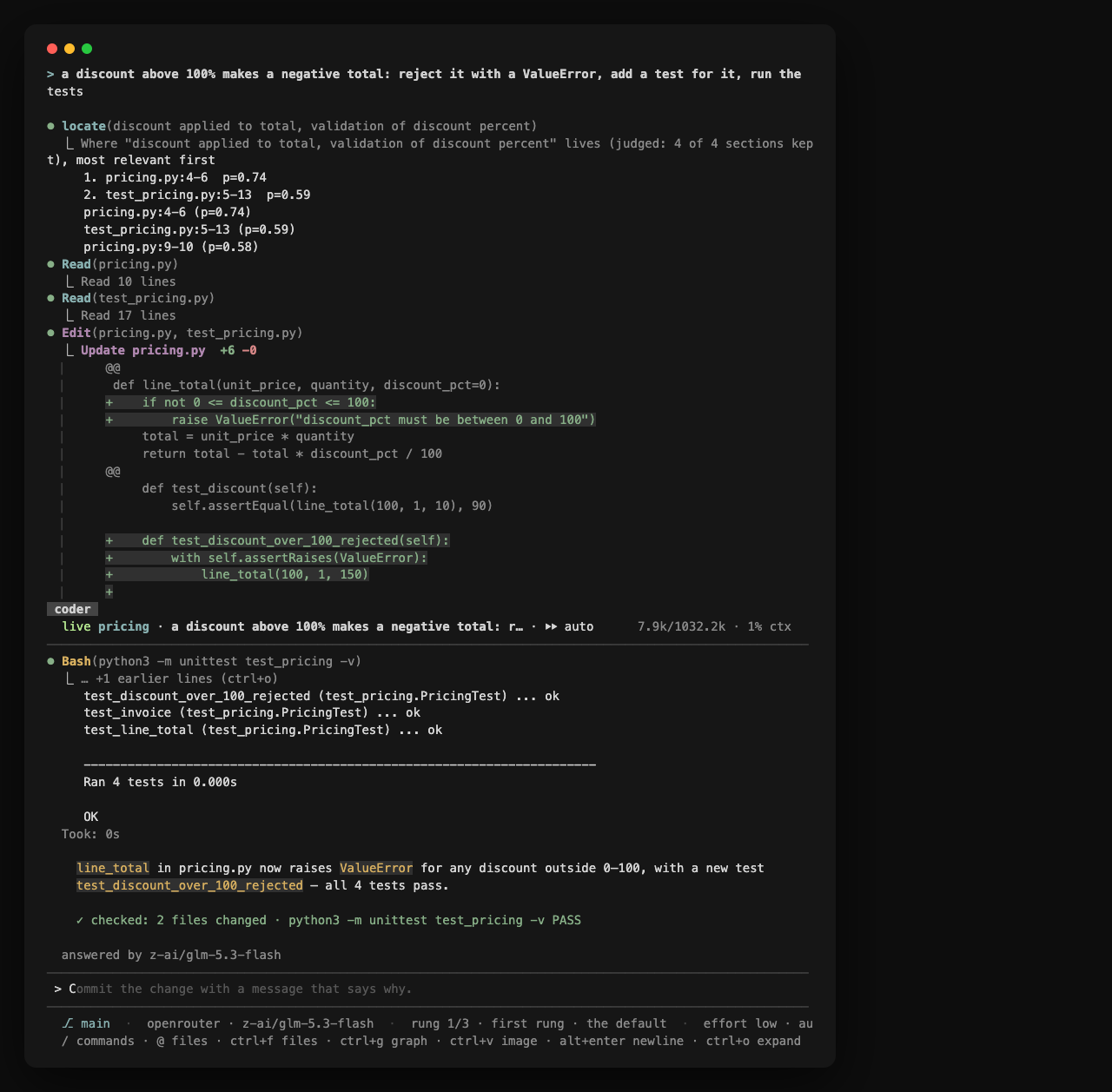
A smaller model can take on several roles rather than attempt an entire problem alone. That is the approach explored in a new experiment published on October 31 by Gregory Desvaux for Memdoor, an open-source coding and automation tool.
The team-solve workflow assigns Qwen3.8-27B planning, two independent solution proposals, implementation and review, followed by a repair step. Each role starts with a fresh conversation context and exchanges information through files. Success is checked by running tests.
A result that needs its boundaries
The creator reports 49 successful runs out of 50, repeating the first ten difficult problems from a LiveCodeBench list five times. He publishes requests, replies, generated programs and grading results. According to his records, completed runs cost $35.79 through OpenRouter, or $38.77 including 16 interrupted attempts.
The sample does not cover the full benchmark. The problems come from 2025 contests, and their possible presence in training data cannot be ruled out. The Fable 5 comparison uses results from another repository rather than a fresh run in the same environment. Independent replication has not been established.
The traces also show coordination failures: a reviewing role invented an incorrect counterexample, prompting the replacement of correct code. More collaboration does not automatically produce a better decision.
The practical opening is that a small team can inspect and modify the work process as well as choose a model. Memdoor is available under Apache-2.0 and connects to different providers or local models. Running the tool locally does not mean data stays on the computer when a cloud provider is selected.
Our sources
- team-solve: Five passes on the authors' ten (2026-10-31) ↗Gregory Desvaux / Memdoor · 31 October 2026 · Checked 1 November 2026
- Memdoor README, installation and data handling ↗Gregory Desvaux / Memdoor · Checked 1 November 2026
- Hacker News discussion linked by project ↗Hacker News · 1 November 2026 · Checked 1 November 2026
AI tools assist our editors. Articles are published after human approval. Practical examples are ΠΕΡΑ analysis unless stated otherwise. How we work